


Our services
- Trichological visit
- PRP treatment
- Infrared helmet
- Pulsed electromagnetic fields
* mandatory fields
** write numbers sum to confirm you're not a bot
Trichological treatments
PRP
PRP is used to improve hair health and stop hair loss. It is a self-treatment that encourages tissue regeneration, can block hair loss, and stimulate growth by nourishing dormant hair follicles.
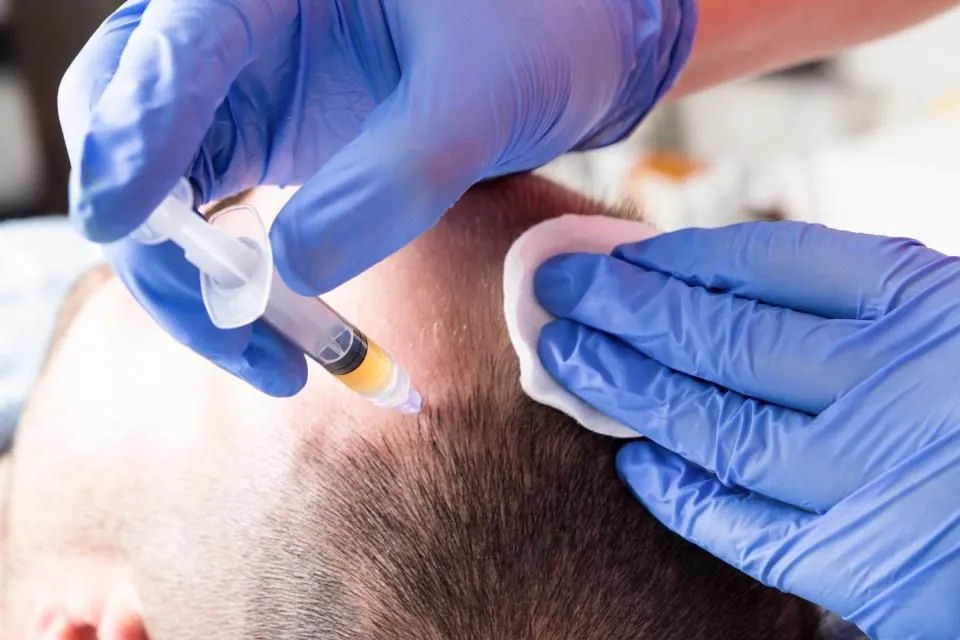
Through a blood draw from the patient, followed by a separation process of the blood components, the stem cell-rich part is obtained and then reinjected either through microinjections or electroporation for rapid and effective tissue regeneration.
Infrared Helmet
For this treatment, a helmet similar to a bicycle helmet, but equipped with infrared technology, is used. This trichology treatment helps improve and stimulate circulation in the scalp and regulate the sebum production of hair follicles, improving hair health.
Pulsed Electromagnetic Fields
For this treatment, a helmet or mat is used and placed near the area to be treated. The controlled and safe electromagnetic fields stimulate peripheral blood circulation, promoting tissue oxygenation and improving hair vitality.
Rinfoltimento
This trichology treatment is carried out using two methods: through a true hair transplant or using new techniques that involve the removal of a tiny portion of dermis, which is then processed in a special way and reinjected with microinjections into the scalp to reactivate the hair follicles. In the trichological and aesthetic field, all procedures are performed after an evaluation of feasibility for each individual patient by the specialist.
Hair transplant? Better with a robot
Italy shares with Spain the record for “bald heads”: one man out of two. To fight androgenetic alopecia, surgery is the main path. Faster, more precise, and more effective, automation is the best ally for both doctor and patient. Here’s why.
“Baldness is a divine thing, not without nobility,” wrote around 400 A.D. the Greek philosopher, diplomat, and bishop Synesius. Those were times when a “bald head”—like white hair—was synonymous with wisdom, experience, and respectability. But above all, there were no alternatives.
Today, baldness—especially at a young age (early androgenetic alopecia)—is perceived as a weakness: an unpleasant sign of aging that can affect self-confidence.
The good news is that baldness can be defeated. After lotions, injections, and follicle-by-follicle treatments, the main solution is transplantation. Effective, long-lasting, and non-invasive, hair transplantation can be suitable for almost all patients between 20 and 65 years old.
Hair loss, a growing market
Hair loss, a growing market
It is no coincidence that the number of anti-baldness procedures is constantly increasing: up 6% per year. In 2021 alone, according to Medihair—a platform that monitors industry trends—about 358,000 procedures were performed in Europe. A clear trend for a sector worth around 9.5 billion dollars annually, expected to exceed 15 billion by 2030.
Italians second in the world for baldness
Statistics show that the average Western male is bald: 24 of the 47 countries with the highest percentage of hairless men are in the West. Italy shares with Spain (at the top of the ranking) the record for bald heads: 44.37%. Practically one man out of two. By age 80, nearly 80% of the male population is bald. In addition, there are about 4 million women affected by alopecia.
But what exactly is androgenetic alopecia? Male-pattern baldness is the hereditary tendency to lose hair. It begins to appear in boys after puberty, when hair becomes thinner and loses density, especially on the forehead. By contrast, hair on the back of the head and temples is genetically permanent and tends to remain stable throughout life.
Smart, robotic, less invasive
Hair autotransplantation is, in short, the transfer of living follicles taken from an area with dense hair—usually the back of the head—to a bald or thinning area. It can be performed manually (one follicle at a time) or with a robot. Faster, less invasive, and more precise, the robot reduces the risk of human error, including surgeon fatigue (the procedure lasts from 4 to 10 hours) and accidental damage to the follicles.
The robot helps the doctor select the best follicles, harvests only healthy grafts, minimizes side effects, and maintains consistent performance. The result? More uniform graft quality and a higher success rate.
The advantages of technology
Automated hair transplantation eliminates a series of human physical, mental, and technical variables such as fatigue, tremors, and lapses, which are inevitable during procedures lasting 4 to 10 hours.
Learn more with
dott.ssa Rita Viscovo
info@maliz.it
phone. +39 02 9309391
For the surgeon
- ensures highly precise instruments capable of bending and rotating beyond human hand abilities;
- provides better visibility of the operating area and allows remote control of the robotic arm.
For the patient
- minimizes the risk of infection and bleeding;
- shortens recovery and hospitalization time;
- compared to manual procedures, graft growth rate is 15–20% higher;
- follicle survival rate ranges from 95% to 98%;
- reduces the need for future touch-up procedures.
This is why, when choosing the path of hair autotransplantation, it is essential to select a medical clinic that uses the most advanced technologies.